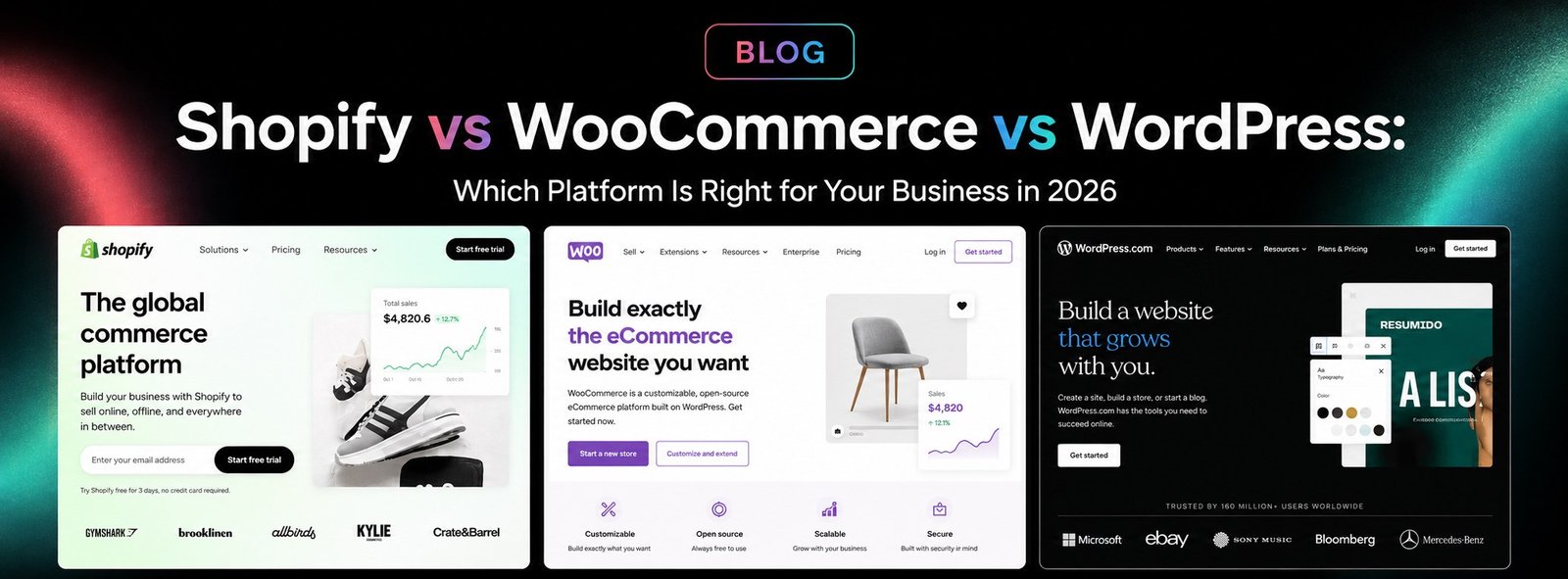
Every founder eventually asks the same question: "What should I actually build my website on?" It sounds like a technical decision, but it's really a business decision — one that affects your costs, your flexibility, and how fast you can grow. At WeOne, we've built and migrated stores on all three platforms, and the honest answer is: it depends on what you're optimizing for.
Here's a clear, no-fluff breakdown.
Key Takeaways
- Shopify wins on speed to launch and zero maintenance, at the cost of subscription fees and app-dependent customization.
- WooCommerce wins on full ownership and long-term cost control, but you own the hosting and security responsibility too.
- Plain WordPress fits service businesses that need leads, not checkout — don't force an e-commerce platform to act like a brochure site.
- Platform choice matters less than execution: load speed, checkout friction, and mobile-first design decide real-world performance.
1. Shopify: Best for Speed to Launch and Zero Maintenance Headaches
Shopify is a fully hosted platform — you're renting the infrastructure, not owning it. That trade-off is exactly why it works so well for certain businesses.
Choose Shopify if:
- You want to launch fast without managing servers, security patches, or backups
- You're selling primarily through one channel and want reliable uptime during sales spikes
- You'd rather pay a predictable monthly fee than hire a developer for every small change
- You plan to scale internationally and want built-in multi-currency and tax handling
The trade-off: Monthly subscription costs add up, transaction fees apply unless you use Shopify Payments, and deep customization often requires paid apps or custom theme development.
2. WooCommerce: Best for Control and Long-Term Cost Efficiency
WooCommerce is a plugin on top of WordPress, which means you own your store completely — the code, the data, the hosting. It's the platform we recommend most often to clients who want to grow without hitting a paywall for every feature.
Choose WooCommerce if:
- You want full ownership of your store with no forced monthly platform fee
- Your catalogue is large or complex and you need custom logic (custom pricing rules, B2B tiers, subscriptions)
- You already have content on WordPress and want commerce built into the same ecosystem
- You want the freedom to switch hosting providers without switching platforms
The trade-off: You're responsible for hosting, security, and updates — or you need an agency partner who handles that for you. This is exactly the gap WeOne fills for WooCommerce clients: we manage the technical side so store owners can focus on selling.
3. WordPress (without WooCommerce): Best for Content-First, Service-Based Businesses
If you're not running a storefront and instead need a fast, credible, content-driven site — a consultancy, an agency, a local service business — plain WordPress (or a custom-built site) is usually the better fit than forcing an e-commerce platform to behave like a brochure site.
Choose WordPress if:
- Your goal is lead generation, not direct online sales
- You need a blog, service pages, and a portfolio that's easy to update yourself
- You want strong SEO fundamentals without e-commerce overhead you don't need
So, Which One Should You Actually Pick?
A simple way to decide:
| Your Situation | Best Fit |
|---|---|
| Launching fast, minimal technical involvement | Shopify |
| Complex catalogue, want full ownership, long-term cost control | WooCommerce |
| Service business, content marketing focus, no direct checkout | WordPress |
| Already have significant traffic/SEO on WordPress, adding a store | WooCommerce |
The Part Most Agencies Won't Tell You
Platform choice matters less than execution. We've seen beautifully "correct" Shopify stores underperform because the UX was cluttered, and we've seen simple WooCommerce sites outsell competitors because checkout friction was removed and page speed was treated as a priority, not an afterthought.
Platform choice matters less than execution.
Whichever platform fits your business model, the fundamentals stay the same: fast load times, a checkout flow with as few clicks as possible, mobile-first design, and clear product information above the fold.
Frequently Asked Questions
Is Shopify or WooCommerce better for SEO?
Neither has an inherent ranking advantage — Google ranks pages, not platforms. WooCommerce gives more control over URLs, schema, and content structure if you have someone managing it properly; Shopify gets non-technical merchants to a fast, clean baseline faster. What actually moves rankings is page speed, content quality, and site structure — all things we optimize for regardless of platform. Once your platform is settled, checking your site's UX for hidden conversion leaks matters just as much as the SEO setup.
Can I switch platforms later if I outgrow my first choice?
Yes, but migrations take planning — product data, SEO redirects, and design all need to move carefully to avoid losing search rankings. It's easier (and cheaper) to pick the right platform up front based on where your business is headed, not just where it is today.
Do I need a developer to run WooCommerce?
Not necessarily for day-to-day content updates, but for hosting, security, performance tuning, and custom features, having an agency or developer on call saves you from the most common WooCommerce pitfall: a slow, poorly maintained store. See our breakdown of how site speed affects conversions for why this matters more than most owners expect.
Still Not Sure?
That's normal — this decision has long-term cost and flexibility implications most business owners aren't equipped to evaluate alone. At WeOne, we start every e-commerce project with a short platform-fit conversation before writing a single line of code, so you're not locked into a system that fights your business model two years from now.
Ready to figure out the right platform for your store?
Get A Call Back
